Completing a research paper feels like the finish line.
It is not.
For many researchers, finishing the manuscript is actually the beginning of a more important decision-making process: where should you submit it, how should you prepare it, and how can you avoid preventable mistakes?
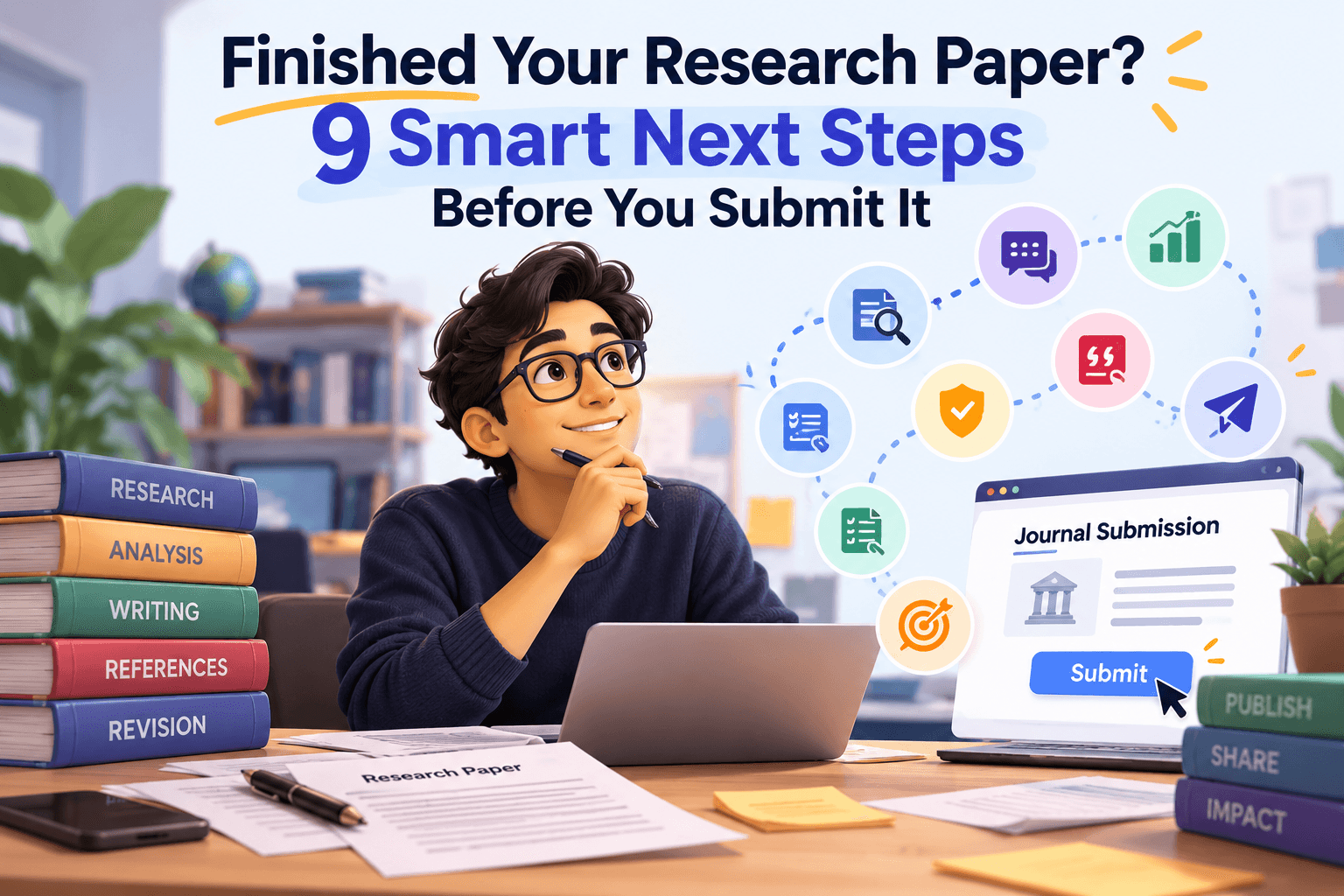
Before clicking “Submit,” take a step back and work through the following nine steps.
1. Read Your Paper Like a Reviewer
Before submitting your manuscript, stop reading it like the author. Read it like a reviewer.
- Is the research problem clearly defined?
- Is the research question specific?
- Is the methodology adequately explained?
- Are the results presented clearly?
- Do the conclusions actually follow from the results?
- Are the limitations acknowledged?
- Does the paper provide a meaningful contribution?
A useful test is simple: If a researcher in your field read only the abstract and conclusion, would they understand why your study matters?
If the answer is no, revise before submitting.
2. Define Your Paper's Real Contribution
One of the most important questions in academic publishing is: What does this paper add to existing knowledge?
Your contribution could be:
- A new methodology
- A new dataset
- A new theoretical perspective
- A new application of an existing method
- New empirical evidence
- A comparison of existing approaches
- A solution to a previously identified research gap
Do not assume that a complicated methodology automatically means a strong contribution. The value of research comes from the problem it addresses and the knowledge it adds.
Try completing this sentence:
“This research contributes to the field by…”
If you cannot finish that sentence clearly, your manuscript may need further refinement.
3. Decide: Journal, Conference, or Both?
Not every research project should follow exactly the same publication path.
A journal submission may be appropriate when you have a complete study with detailed methodology, results and discussion.
A conference may be useful when you want to:
- Present emerging research
- Receive feedback
- Discuss preliminary findings
- Connect with researchers in your field
- Explore collaboration opportunities
- Understand current research directions
In some disciplines, conferences are particularly important for knowledge exchange and professional networking.
The important point is to understand the purpose of your submission before choosing the venue.
4. Choose the Publication Venue by Fit, Not Just by Name
One of the biggest mistakes researchers make is selecting a journal only because they have heard its name.
Instead, evaluate the fit.
- Scope — Does the journal actually publish research related to your topic?
- Recent Articles — Read several recently published papers. Do they resemble your research in subject, methodology or audience?
- Editorial Information — Look for clear information about the editorial team and publication process.
- Peer Review — Understand how the journal describes its peer-review process.
- Author Guidelines — Check formatting, manuscript structure, references, word limits and submission requirements.
- Publication Information — Check the journal's ISSN, publisher information, publication frequency and other relevant details.
A journal that looks impressive but is poorly aligned with your research may be a worse choice than a less famous journal with a much stronger subject fit.
5. Verify Indexing Instead of Trusting a Badge
Researchers often search for terms such as “Scopus indexed journal.”
But seeing an indexing logo on a website should not be the end of your verification process.
If indexing matters for your academic requirement, verify the journal through the official database or indexing provider and check the journal's current status.
This is particularly important because indexing status can change.
Do not make a publication decision based solely on:
- A website badge
- A promotional advertisement
- A third-party list
- A screenshot
- An old article
- Someone else's recommendation
Verify before you submit.
6. Check for Predatory or Unclear Publishing Practices
A professional-looking website does not automatically guarantee a trustworthy publication process.
Before submission, look for transparency. Ask:
- Is the publisher clearly identified?
- Is the editorial board publicly available?
- Is the peer-review process explained?
- Are publication fees clearly disclosed?
- Are contact details available?
- Are submission guidelines detailed?
- Is the journal's publication history visible?
- Are claims about indexing independently verifiable?
Be especially cautious when a publication promises guaranteed acceptance or unrealistically fast publication without a credible explanation of its review process.
Academic publishing requires evaluation. There should be no need to hide that process.
7. Follow the Author Guidelines Exactly
A good manuscript can be delayed simply because the author did not follow the journal's instructions.
Before submission, check:
- Formatting: Font, line spacing, page layout, headings, tables and figures
- Manuscript structure: Title, abstract, keywords, introduction, methodology, results, discussion, conclusion and references
- References: Citation style, reference format, DOI requirements and in-text citation consistency
- Figures and tables: Resolution, captions, numbering and placement
Think of the author guidelines as a technical specification. Your manuscript should satisfy the specification before you submit it.
8. Check Ethics, Originality and Research Integrity
Before submitting, make sure your paper meets the ethical expectations of the target publication.
- Plagiarism and originality
- Proper citation
- Authorship
- Conflicts of interest
- Data availability
- Research permissions
- Ethical approvals where applicable
- Duplicate or simultaneous submission issues
One important rule: Do not submit the same manuscript to multiple journals simultaneously unless the publication policies explicitly allow it.
When in doubt, check the journal's stated policies.
9. Prepare for What Happens After Submission
Submission is not the end of the process.
Depending on the publication venue, your manuscript may go through stages such as:
Submission → Initial screening → Editorial assessment → Peer review → Revision → Final decision → Production → Publication
A reviewer may ask you to:
- Clarify your methodology
- Add references
- Improve analysis
- Explain limitations
- Rewrite sections
- Address specific reviewer comments
A revision request is not necessarily a rejection. In many cases, it is part of the normal scholarly publishing process.
The key is to respond professionally and systematically. Create a response document that lists each reviewer comment and explains exactly how you addressed it.
A Simple Pre-Submission Checklist
Research Quality
- ☐ Is the research problem clearly defined?
- ☐ Is the research contribution clear?
- ☐ Is the methodology sufficiently explained?
- ☐ Are the results supported by the analysis?
- ☐ Are limitations discussed?
Publication Venue
- ☐ Does the journal/conference match my research scope?
- ☐ Have I reviewed recent publications?
- ☐ Have I checked the publisher and editorial information?
- ☐ Have I independently verified important indexing claims?
Manuscript
- ☐ Does the paper follow the author guidelines?
- ☐ Are references formatted correctly?
- ☐ Are tables and figures properly labelled?
- ☐ Is the manuscript proofread?
Research Integrity
- ☐ Is the work original?
- ☐ Are all sources properly cited?
- ☐ Are authorship details correct?
- ☐ Have ethical requirements been addressed?
- ☐ Am I avoiding simultaneous submission?
The Most Important Question Before You Submit
Instead of asking:
“Where can I publish this paper?”
Ask:
“Where is this research most relevant, credible and useful to the academic community?”
That small change in thinking can completely change your publication strategy.
Final Thought
Research does not end when the manuscript is complete.
There is a second stage that requires just as much attention:
- Choosing the right venue.
- Preparing the manuscript correctly.
- Verifying publication information.
- Understanding the review process.
- And protecting the integrity of your research.
A thoughtful submission strategy can save researchers time, reduce avoidable mistakes and create a stronger path from research idea → manuscript → scholarly communication.
At ZEP Research, our broader academic ecosystem includes conferences, publications, research training, manuscript preparation, peer-review support and networking opportunities designed to help researchers move through different stages of their academic journey.
Research better. Submit smarter. Build connections that matter.