What if the next major technological breakthrough could help us use less energy, produce less waste, and build more resilient communities?
Technology is evolving rapidly, but the real challenge is no longer simply creating something new. It is developing solutions that improve human life while reducing pressure on the planet.
In 2026, sustainability is increasingly connected with artificial intelligence, digital simulations, advanced materials, intelligent infrastructure, and data-driven decision-making. These developments are creating new research opportunities across engineering, environmental science, agriculture, manufacturing, and urban planning.
The next phase of sustainable development will depend on more than individual inventions. It will require technologies that work together, scientific research that can be tested in real conditions, and collaboration between different fields.
1. Digital Twins: Testing the Future Before Building It
Imagine creating a virtual version of a real building, factory, transport network, or water distribution system. Researchers could use this digital model to examine how the real system might perform under different conditions before making expensive physical changes. This is the basic idea behind a digital twin.
When connected with live sensor data and analytical tools, digital twins can help identify inefficiencies, compare possible improvements, and anticipate maintenance needs. For example, a city could simulate changes to traffic management or water distribution before implementing them across an area.
Why it matters: Digital twins can support better planning, reduce avoidable resource use, and help researchers evaluate sustainability strategies before putting them into practice.
2. Green Artificial Intelligence: Making AI More Sustainable
Artificial intelligence can help analyse complex environmental data, improve energy forecasting, and support more efficient industrial operations. However, developing and running powerful AI systems also requires computing resources and electricity.
Green AI focuses on energy-efficient computing, smaller or more efficient models, carbon-aware computing, and responsible use of digital infrastructure. Researchers can also explore how AI might optimize electricity consumption in buildings, factories, and renewable energy networks.
Why it matters: Sustainable AI must consider both the environmental benefits it creates and the resources it consumes.
3. Circular Manufacturing: Designing Waste Out of Production
Many production systems follow a linear approach: extract resources, manufacture products, use them, and eventually discard them. Circular manufacturing offers a different model. It encourages businesses to design products that last longer, recover valuable materials, repair components, and reuse resources wherever possible.
Digital tools can help manufacturers track materials throughout a product's lifecycle, identify waste in production processes, and improve recycling decisions. AI and connected sensors may also help predict when equipment requires maintenance, preventing premature replacement.
Why it matters: Circular manufacturing can support more responsible resource use while creating opportunities for material recovery and sustainable product design.
4. Climate-Resilient Agriculture: Growing Smarter in an Uncertain Climate
Agriculture faces challenges from changing weather patterns, water shortages, soil degradation, and unpredictable growing conditions. AI-assisted forecasting, satellite observations, soil sensors, and precision irrigation can help farmers understand local conditions and make more informed decisions.
For example, a sensor-based irrigation system could use soil moisture information to help determine when a field needs water instead of relying entirely on fixed watering schedules.
Why it matters: Combining agricultural knowledge with modern technology can support more efficient farming and strengthen food-system resilience.
5. Smart Energy Systems: Moving Beyond Renewable Power
Generating electricity from renewable sources is important, but energy must also be stored, distributed, and used efficiently. Smart grids, battery storage, intelligent energy management, and demand forecasting can help balance electricity supply and demand.
Buildings may use automated systems to adjust heating, cooling, and lighting according to occupancy and energy requirements. Researchers are also exploring how electric vehicles, distributed energy resources, and local energy networks can work together.
Why it matters: Integrating clean generation with efficient storage and intelligent distribution can help create more flexible and resilient energy systems.
6. Bio-Based Materials: Rethinking the Products We Use
Research into agricultural-waste materials, bio-based packaging, and biodegradable products may help identify new ways to use resources that would otherwise be discarded. These materials may offer alternatives to some conventional products, depending on their performance and environmental impacts.
However, a material is not automatically sustainable simply because it is labelled natural or biodegradable. Its environmental performance depends on production methods, durability, transportation, and end-of-life treatment.
Why it matters: Material innovation can help researchers and manufacturers explore alternatives that balance performance, affordability, and environmental responsibility.
7. Planetary Intelligence: Connecting Data to Environmental Decisions
Environmental challenges rarely exist in isolation. Water availability, land use, energy consumption, biodiversity, and climate risks can influence one another. Planetary intelligence combines environmental observations, satellite data, scientific models, and computational analysis to improve understanding of these interconnected systems.
Researchers can use these approaches to investigate deforestation, monitor changing ecosystems, assess flood risks, and evaluate environmental scenarios. The objective is not simply to collect more data, but to turn reliable information into decisions.
Why it matters: Better environmental intelligence can support evidence-based planning, early risk assessment, and more informed sustainability policies.
The Bigger Challenge: Turning Innovation Into Real-World Impact
Although these technologies offer promising possibilities, successful innovation requires more than technical development. A solution must be tested, evaluated, and adapted to the environment in which it will be used. Researchers must consider affordability, accessibility, data privacy, infrastructure requirements, and long-term environmental effects.
For example, an AI-powered system may improve efficiency but still require significant computing resources. A renewable material may reduce reliance on conventional plastics but create new challenges in manufacturing or disposal.
This is why sustainability research needs measurable outcomes rather than assumptions. Energy savings, material consumption, emissions, water use, durability, and lifecycle impacts are useful measures for evaluating whether a technology delivers meaningful benefits.
Interdisciplinary collaboration is equally important. Engineers can develop technical systems, environmental scientists can assess ecological effects, economists can evaluate financial feasibility, and policymakers can help translate evidence into practical action.
Why International Research Collaboration Matters in 2026
Many sustainability challenges cross national borders. Climate risks, resource management, clean energy development, and responsible technology adoption require knowledge and experience from different regions and disciplines.
International academic conferences provide a platform for researchers to present original work, exchange ideas, receive feedback, and identify potential collaborations. They also create opportunities for early-career researchers and PhD scholars to share findings with a wider academic community.
By bringing together different perspectives, research events can help turn promising concepts into stronger research questions and practical solutions.
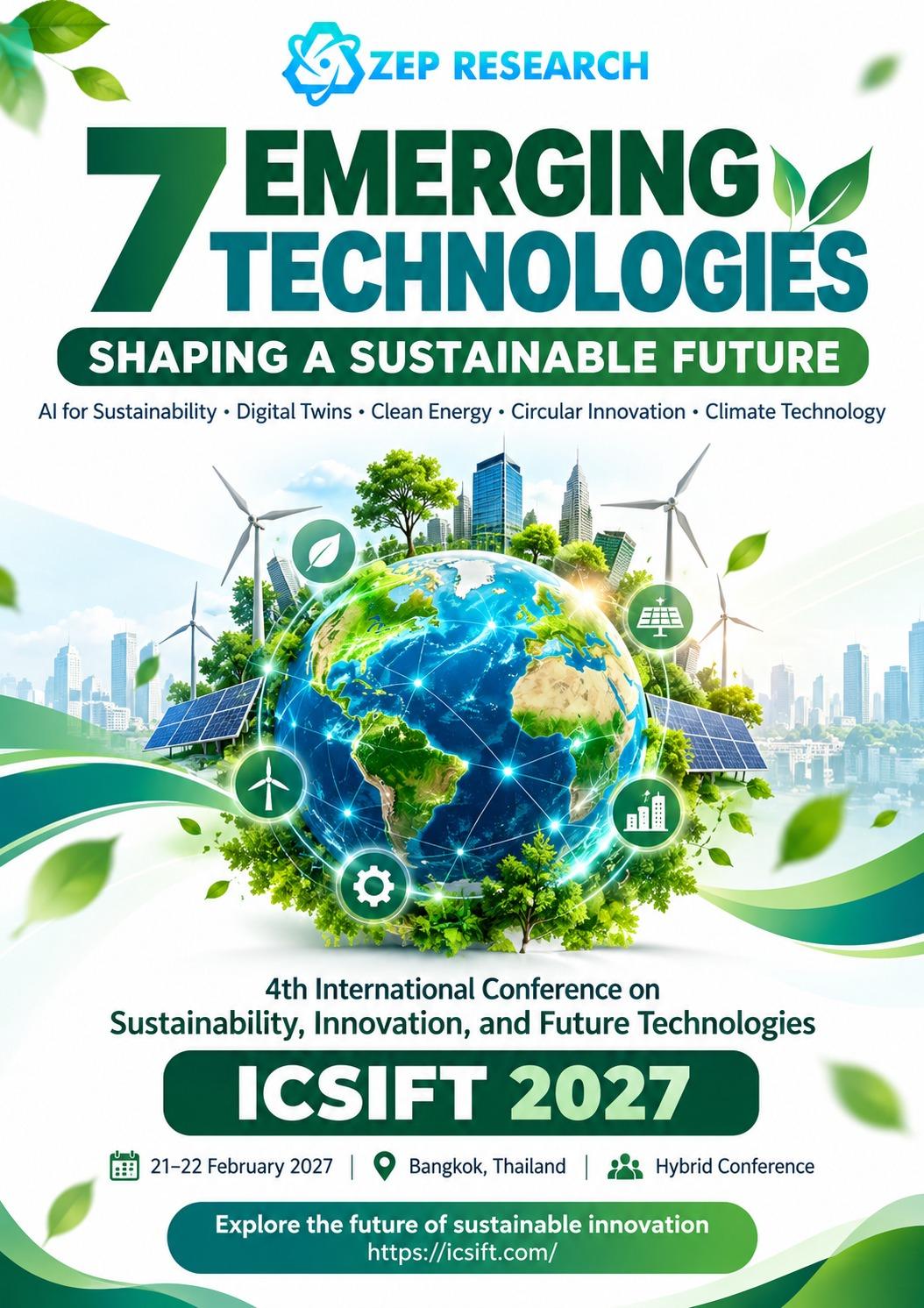
Join the 4th International Conference on Sustainability, Innovation, and Future Technologies (ICSIFT 2027)
The 4th ICSIFT 2027 is scheduled for February 21–22, 2027, with in-person and online participation options. The official conference homepage currently lists Bangkok, Thailand, as the location.
The conference provides a platform for researchers, academics, PhD scholars, and industry professionals interested in sustainability, technological innovation, engineering, and future-oriented research.
Whether you are investigating energy-efficient systems, developing sustainable materials, studying climate resilience, or exploring the relationship between AI and environmental responsibility, sharing your research can contribute to broader academic discussions.
Participants can explore opportunities to present their work, exchange knowledge, and connect with professionals working across different disciplines.
Have an idea that could contribute to a more sustainable future? Bring your research into the conversation.
Explore conference details, submission guidelines, and registration information:
Visit the official ICSIFT 2027 website
- Conference dates: February 21–22, 2027
- Location: Bangkok, Thailand
- Participation: In person and online
Conclusion: The Future Belongs to Responsible Innovation
The most meaningful technological advances will not necessarily be the most complicated or expensive. They will be the solutions that address genuine problems, use resources responsibly, and deliver benefits that can be demonstrated in real-world conditions.
From digital twins and Green AI to circular manufacturing and climate-resilient agriculture, emerging innovations are opening new directions for research and development. Their success will depend on scientific evidence, responsible implementation, and collaboration between people with different expertise.
How can we make technological progress work better for both people and the planet? Answering that question begins with research, grows through collaboration, and advances through responsible action.
Explore new ideas. Share your research. Contribute to a more sustainable future with ICSIFT 2027.